Family game night doesn’t have to be complicated or competitive to be fun.
If you’re trying to spend more time together without screens, board games can be a simple and enjoyable way to reconnect. The challenge, however, is finding games that are easy enough for everyone — especially when young kids are involved.
The good news is that there are plenty of board games that don’t require long rule explanations, complicated setups, or constant adult supervision. Many of the best family games are quick to learn, fast to play, and enjoyable for both kids and adults — and far less likely to end in tears because someone’s favourite unicorn was suddenly blown up by “unicorn poison”.
In this article, we’ll share 10 easy board games that work well for family game night — no screens, no stress, and no prior board game experience required.
Why Screen-Free Board Games Work So Well for Families
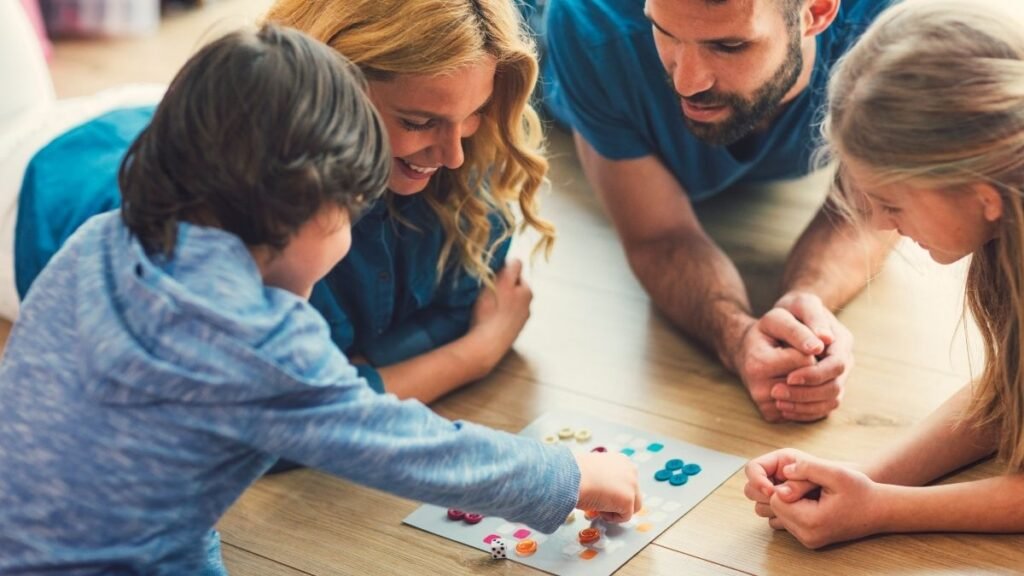
Screen-free board games encourage shared attention and real bonding time. Unlike digital games or television, they invite everyone to sit together, take turns, and interact face to face.
Not all board games work well for family game night, though. Games with quick rules, short setup times, and regular participation tend to keep kids engaged and make the experience enjoyable for everyone.
That’s exactly what the games in this list aim to do.
Jump to a game
10 Easy Board Games for Family Game Night
🧸 Game #1: Animal Upon Animal
Animal Upon Animal is a simple stacking game where players take turns placing wooden animals on top of one another, trying not to make the whole pile tumble.
There’s no board to read, no cards to decipher, and no strategy to explain. Kids roll a die, pick up an animal, and carefully balance it on the growing stack. That’s it — and that’s exactly why it works so well for younger children.
The real magic happens when the tower inevitably collapses. Instead of groans or frustration, most families end up laughing and immediately rebuilding. It’s a fantastic way to introduce turn-taking, patience, and fine motor control without any pressure to “win”.
If you’re looking for a first proper board game for preschoolers, this one is hard to beat.
Best for: Ages 4+
Players: 2–4 (best with 3-4)
Playtime: ~15 min
Difficulty: 👣
Text level: No reading
Why it works: Simple stacking builds coordination and confidence.
🃏 Game #2: Dobble (Spot It!)
Dobble is a fast-paced card game where every card has exactly one matching symbol with every other card — and it’s your job to spot it first.
What makes Dobble such a hit with families is how quickly it gets going. The rules take less than a minute to explain, rounds are short, and everyone plays at the same time. There’s no waiting for turns, which is great news if you’re playing with energetic kids.
It’s also one of those games where kids often beat adults simply because they’re faster at spotting patterns. This can be incredibly satisfying for children — and slightly humbling for parents.
Just be prepared for excited shouting and triumphant finger-pointing. That’s all part of the fun.
Best for: Ages 5+
Players: 2–8 (best with 4-5)
Playtime: ~15 min
Difficulty: 👣
Text level: No reading
Why it works: Fast symbol matching keeps everyone alert and involved.
✨ Game #3: Loopin’ Louie
Loopin’ Louie looks more like a toy than a board game — and that’s a big part of its appeal.
Players take turns tapping a lever to keep a spinning plane from knocking their chickens off their perch. The rules are incredibly simple, and rounds are over in minutes, which makes it perfect for younger kids with short attention spans.
What really sets Loopin’ Louie apart is the physical interaction. There’s movement, anticipation, and a lot of laughter when the plane suddenly dives at the worst possible moment. Winning feels exciting, but losing doesn’t feel bad — which is exactly what you want in a family game.
It’s loud, silly, and chaotic in the best way.
Best for: Ages 5+
Players: 2–4
Playtime: ~10 min
Difficulty: 👣👣
Text level: No reading
Why it works: Physical reflex play creates instant excitement and laughs.
🏗️ Game #4: Rhino Hero
Rhino Hero combines a light card game with a physical stacking challenge, and it’s one of those games that looks simple… right until the tower starts wobbling.
Players take turns building a structure out of cards while moving a superhero rhino higher and higher. There’s no reading involved, and the rules are easy to understand even for younger kids. The challenge comes from steady hands, patience, and resisting the urge to rush.
What makes Rhino Hero especially family-friendly is how it handles failure. When the tower collapses (and it will), the reaction is usually laughter, not frustration. That makes it a great game for teaching focus and fine motor skills without pressure.
Best for: Ages 5-7+
Players: 2–5 (best with 3–4)
Playtime: ~15 min
Difficulty: 👣👣
Text level: No reading
Why it works: Simple dexterity and balancing keep kids fully engaged.
🦊 Game #5: Outfoxed!
Outfoxed! is a cooperative mystery game where players work together to figure out which fox stole a pie.
Instead of competing against one another, everyone is on the same team. Players roll dice, collect clues, and eliminate suspects together. This makes Outfoxed! an excellent choice for families who want less rivalry and more teamwork at the table.
The deduction is gentle and visual, and adults can easily guide younger players without taking over. It also opens up space for discussion — kids talk through ideas, make group decisions, and celebrate wins together.
If you’re looking for a game that encourages cooperation rather than competition, this is a standout choice
Best for: Ages 5–8+
Players: 2–4
Playtime: ~20 min
Difficulty: 👣👣
Text level: Minimal reading
Why it works: Cooperative play encourages teamwork and shared decision-making.
🍣 Game #6: Sushi Go!
Sushi Go! is a fast-paced card game where players pick a card, pass the rest along, and try to collect the best combinations of sushi.
Despite introducing a bit more thinking, Sushi Go! remains very approachable. The artwork is cute, turns are quick, and players learn the flow of the game after just one round. Kids enjoy choosing their favourite foods, while adults appreciate the small decisions involved.
It’s also great for teaching turn-taking and planning without slowing things down. No one is ever completely out of the game, which helps keep emotions in check — an underrated feature for family game nights.
Best for: Ages 6–8+
Players: 2–5 (best with 4–5)
Playtime: ~15–20 min
Difficulty: 👣👣
Text level: Minimal reading
Why it works: Fast-paced card passing keeps turns quick and engaging.
👻 Game #7: Ghost Blitz
Ghost Blitz is a fast reaction game that rewards sharp eyes and quick hands.
Players race to grab the correct object based on what appears on a card — sometimes matching colours and shapes exactly, and sometimes doing the opposite. It sounds simple, but once the pace picks up, things get hilariously chaotic.
Kids love the physical aspect of grabbing objects, and adults often find themselves just as flustered. It’s loud, energetic, and full of sudden reversals — perfect for families who enjoy games with lots of movement and excitement.
Best for: Ages 6–8+
Players: 2–8 (best with 3–5)
Playtime: ~20 min
Difficulty: 👣👣
Text level: Minimal reading
Why it works: Fast observation and quick reactions create exciting, active play.
🗺️ Game #8: My First Carcassonne
My First Carcassonne is a simplified version of the classic tile-laying game, designed especially for younger players.
Instead of complex scoring, kids place tiles to build roads and castles, then move their pieces to claim completed paths. Everything is visual, intuitive, and easy to follow — no reading required.
This game is a gentle introduction to planning and spatial thinking. Kids start learning how their choices affect the board, while adults appreciate how calm and focused the gameplay feels compared to faster, louder games.
Best for: Ages 4–7+
Players: 2–4
Playtime: ~10–20 min
Difficulty: 👣👣
Text level: No reading
Why it works: Simple tile placement builds planning and spatial awareness.
🐱 Game #9: Felicity – The Cat in the Sack
Felicity: The Cat in the Sack is a light guessing and bidding game where players take turns drawing cats from a bag — without knowing exactly what they’re getting.
Each cat has a value, and players must decide when to stop drawing before they push their luck too far. The tension comes from not knowing what’s next, and the delight comes from revealing a perfect (or disastrous) pull.
What makes this game work for families is its emotional lesson: learning when to take a risk, and when to walk away. Kids quickly grasp the idea, and the cute theme keeps things playful rather than stressful.
Best for: Ages 6–9+
Players: 3–5
Playtime: ~20 min
Difficulty: 👣👣👣
Text level: Minimal reading
Why it works: Guessing and risk-taking create exciting, suspenseful moments.
🎨 Game #10: Dixit
Dixit is a storytelling and imagination-based game where players give clues using beautifully illustrated cards.
One player gives a clue — a word, phrase, or even a sound — and others choose a card from their hand that best matches it. The challenge is to be just vague enough: not too obvious, but not too confusing either.
Dixit shines with slightly older kids who enjoy expressing ideas and interpreting others’ thoughts. There’s no pressure to “outplay” anyone, and the game often sparks conversations and laughter long after the round ends.
Best for: Ages 8+
Players: 3–6
Playtime: ~30 min
Difficulty: 👣👣👣
Text level: Reading required
Why it works: Encourages creativity, imagination, and thoughtful discussion.
🧭 How to Choose the Right Game for Your Family
Choosing a board game doesn’t have to be complicated. The best game for your family is usually one that fits your child’s age, attention span, and reading ability — not necessarily the one with the most hype.
If you’re playing with younger children or first-timers, start with games that require little to no reading and have short playtimes. Games that focus on matching, stacking, or quick reactions tend to work well and help build confidence.
For families with slightly older kids, introducing light decision-making or cooperative play can be a great next step. These games encourage discussion, teamwork, and planning without becoming overwhelming.
Most importantly, don’t worry too much about “getting it right.” If a game brings everyone to the table, sparks a few laughs, and ends without frustration, that’s already a win.
💭 Final Thoughts
All the games on this list are ones I’ve personally played — both with kids and with adults. They’ve made it to the table not just because they’re child-friendly, but because they’re genuinely enjoyable even if you’re not a hardcore board gamer.
These are the kinds of games that work well for casual players — parents, relatives, or friends who want to have fun without spending 30 minutes learning rules. They’re also a great stepping stone if you’re curious about board games but not quite ready to dive into heavier titles like Terraforming Mars, Scythe, or Gloomhaven.
Board games don’t have to be long or complex to be meaningful. Often, the most memorable moments come from quick rounds, shared laughter, and games that everyone feels comfortable playing.
If a game brings your family to the table, keeps screens away for a while, and leaves everyone smiling at the end, it’s already doing something right.
Pingback: How to Start a Screen-Free Family Game Night (Even If You’re Busy) – Screen Free Playtime
Pingback: Best Board Games for Kids Aged 5–7 (Beginner-Friendly Picks) – Screen Free Playtime
Pingback: Best Cooperative Board Games for Kids (Play Together, Not Against) – Screen Free Playtime
Pingback: 30 Screen-Free Rainy/Hot Day Activities for Kids
Pingback: 10 Best Board Games for Family Game Night (Ages 5–10) - Screen Free Playtime
Pingback: 8 Family Board Games Like Sushi Go for Screen-Free Fun