Finding board games for kids aged 5–7 can feel surprisingly tricky.
Some games look cute but can be utterly confusing.
If you’re looking for beginner-friendly board games that actually work for this age group — simple rules, short playtime, and minimal meltdowns (can’t guarantee none! :p) — this guide is here to help.
These are the kinds of games that:
- Don’t require reading
- Can be explained in minutes
- Keep everyone in the game
- Work well for real family game nights
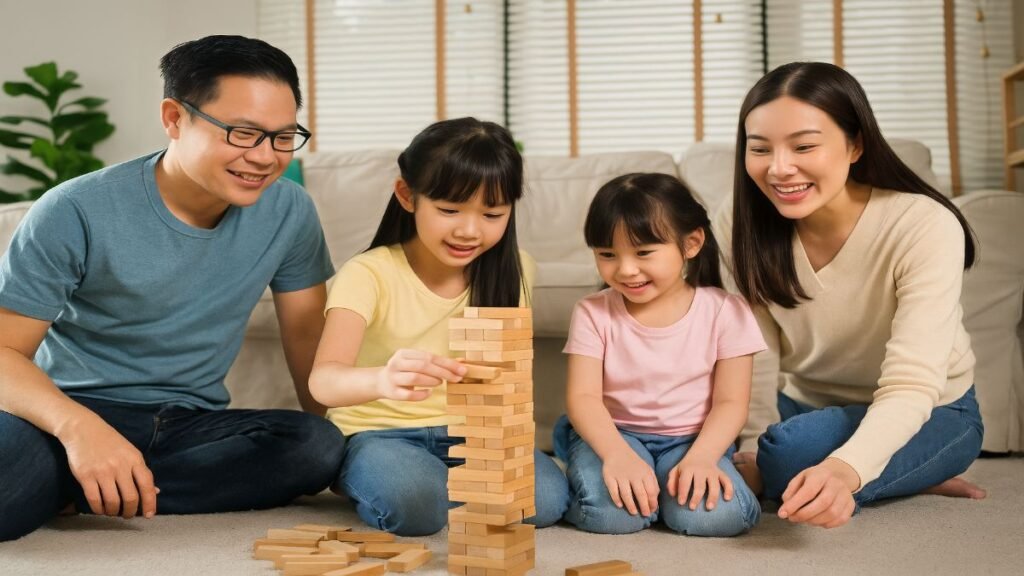
What Makes a Good Board Game for Ages 5–7?
Before getting into categories, it helps to know what actually works at this stage.
At this age, the best board games tend to share a few key traits:
- Simple rules (explained in under 5 minutes)
- Short playtime (10–20 minutes is ideal)
- No early elimination (everyone stays involved)
- Clear goals (kids know what they are working towards)
Games that are too long, too wordy, or too complicated often ends with boredom — or tears.
If you’re looking for specific beginner-friendly board games that work well for family game nights, you can also check out our full guide to easy board games for family game night.

⭐ Best Board Games for Kids Aged 5–7
1️⃣ Rhino Hero
Best for: Ages 5–7
Players: 2–5 (best at 3–4)
Play time: ~10–15 minutes
Difficulty: 👣
Text-heavy: No
Why it works: Combines stacking, balance, and excitement without any reading.
A brilliant dexterity game where kids build a tower of cards and move a superhero rhino upward. It’s physical, fast, and full of laughs — and even adults get nervous hands.
2️⃣ Dobble
Best for: Ages 5–7
Players: 2–6 (best at 2–4)
Play time: ~5–10 minutes
Difficulty: 👣
Text-heavy: No
Why it works: Quick symbol-matching keeps kids engaged and energised.
Dobble is great for short attention spans. Every round is fast, rules are simple, and kids can jump straight in without explanations.
3️⃣ Animal Upon Animal
Best for: Ages 5–7
Players: 2–4
Play time: ~10–15 minutes
Difficulty: 👣
Text-heavy: No
Why it works: Encourages fine motor skills and patience through stacking.
Players take turns stacking wooden animals — and trying not to knock everything over. It’s calm, tactile, and surprisingly tense in a fun way.
4️⃣ Outfoxed
Best for: Ages 5–7
Players: 2–4 (cooperative)
Play time: ~15–20 minutes
Difficulty: 👣👣
Text-heavy: Very little
Why it works: Cooperative play removes competition and builds teamwork.
Instead of playing against each other, players work together to solve a mystery. This makes it ideal for families who want fewer arguments and more shared wins.
5️⃣ Felicity: The Cat in the Sack
Best for: Ages 6–7
Players: 3–5
Play time: ~15–20 minutes
Difficulty: 👣👣
Text-heavy: No
Why it works: Simple bidding mechanics introduce risk and decision-making.
This game feels playful and light, yet introduces kids to basic strategy in a very approachable way. The cat theme also helps keep things fun and silly.
6️⃣ Sushi Go
Best for: Ages 6–7
Players: 2–5 (best at 3–4)
Play time: ~15 minutes
Difficulty: 👣👣
Text-heavy: Minimal
Why it works: Card drafting is easy to learn and fast to play.
Kids quickly grasp the idea of choosing a card and passing the rest along. The cute artwork helps younger players remember what each card does.
7️⃣ UNO (House Rules Version)
Best for: Ages 5–7
Players: 2–6
Play time: ~10–20 minutes
Difficulty: 👣👣
Text-heavy: Some
Why it works: Familiar gameplay with flexible rules keeps frustration low.
UNO works best when rules are simplified. Skipping complicated cards early on makes it much more beginner-friendly for younger kids.
8️⃣ Dixit
Best for: Ages 7+
Players: 3–6
Play time: ~20–30 minutes
Difficulty: 👣👣👣
Text-heavy: No
Why it works: Encourages creativity, imagination, and storytelling.
Best for slightly older kids or mixed-age groups, Dixit has no reading but does require abstract thinking. It’s a great bridge toward more complex games later on.
Beginner-Friendly Types of Board Games for Kids (5–7)
The above types of games tend to work especially well at this stage as they fall into the categories below.
Memory and matching games: often the easiest entry point. They require no reading, use familiar images, and are easy to adjust by adding or removing cards.
Simple dice-and-move games: Can still work, as long as they move quickly and don’t drag on. Shorter boards and faster turns usually lead to better experiences.
Cooperative games are especially helpful for this age group. Playing toward a shared goal often reduces arguments and keeps game night positive.
Light strategy games — such as colour matching or simple placement — help kids practise decision-making without overwhelming them.
Finally, fast, playful party-style games are great when attention spans are short. Quick rounds and a bit of silliness go a long way.
How to Introduce Board Games to Kids Without Resistance
A few simple habits make a big difference:
- Demonstrate one round instead of explaining all the rules
- Play a practice game where winning doesn’t matter
- Let kids win early on to build confidence
If you’re new to this, our guide on starting a screen-free family game night walks through how to make game night enjoyable — even on busy evenings.
How Long Should Board Games Last for Ages 5–7?
A simple rule works well here:
- 10–20 minutes is the sweet spot
- If kids say “Again, again,” you know you have hit the jackpot.
Ending a game while it’s still fun is better than pushing through to the end.
Final Thoughts
The best board games for kids aged 5–7 aren’t the fanciest ones.
They’re the games that:
- Get taken off the shelf again (My eldest son at 7 years old can play with his 5 years old brother on their own now)
- Create laughter at the table
- Feel easy, not exhausting
Start simple.
Build confidence.
And let your family’s favourites grow naturally over time.
Pingback: Best Board Games for Kids Aged 8–10 (Easy to Learn, Still Fun for Adults) – Screen Free Playtime
Pingback: 5 Card Games That Take Under 10 Minutes (2026) – Screen Free Playtime
Pingback: 5 Cooperative Board Games for Kids That Encourage Teamwork (2026) – Screen Free Playtime
Pingback: 30 Screen-Free Rainy / Hot Day Activities for Kids (That Actually Work) – Screen Free Playtime
Pingback: Best Cooperative Board Games for Kids (Play Together, Not Against) – Screen Free Playtime
Pingback: How to Get Kids Off Screens (Without a Fight) - Screen Free Playtime
Pingback: How to Start a Screen-Free Family Game Night (Even If You’re Busy) - Screen Free Playtime
Pingback: 7 Indoor Activities for Kids (When you are too tired)
Pingback: How to teach your child a new board game.