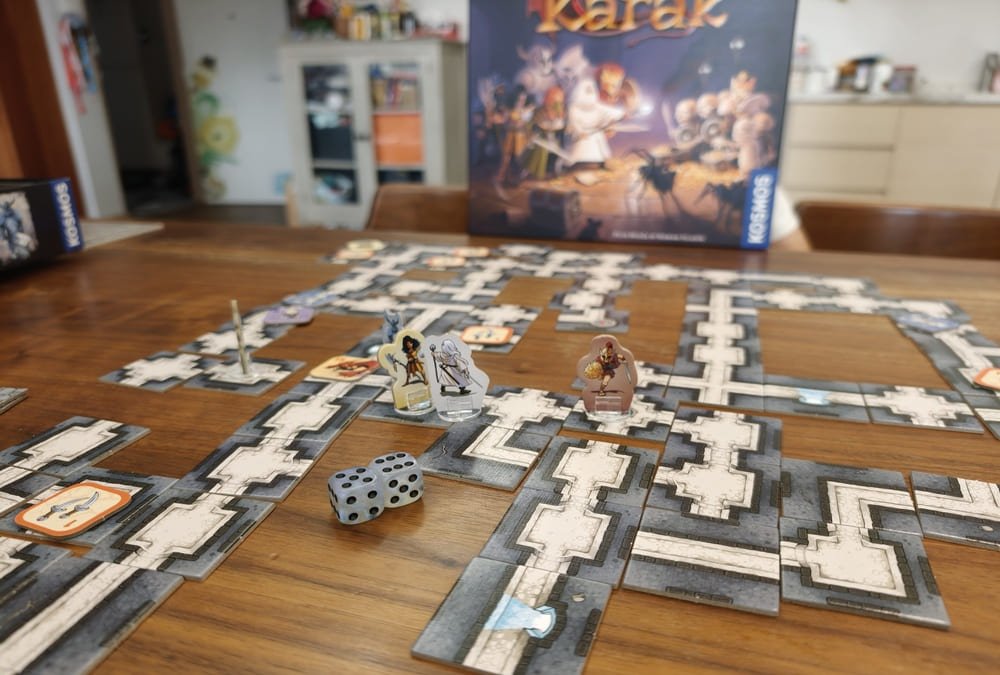
The box says 45 minutes. We ended up playing for two and a half hours — on a lazy Sunday afternoon, the very last day of the June holidays, right after I’d collected the shiny new “toy” from a Carousell seller who still had it shrink-wrapped the day itself. Ah, the delights of cracking open a crisp new box.
The kids were buzzing the whole way through. It was Miley who quietly started nodding off between turns, back in the early stretch when the four of us were still deliberating over every single move. She woke up fast for the dragon, mind you. Nobody sleeps through that.
I’m still a bit fuzzy about it days later, if I’m being straight. Not the kids re-telling it at breakfast or anything dramatic — just me, quietly wanting to set it all up again. The only thing stopping us is the clock. Karak doesn’t fit into a weekday night, not the way we play it, and that’s the honest catch I’ll come back to at the end.
So it’s earned a proper writeup instead of the one line I gave it in my [fantasy board games roundup].
What Karak actually is
If you’ve never seen it: Karak is a dungeon crawler dressed down for kids. You start on a single tile and build the dungeon as you go, flipping a new tile each turn and walking into whatever’s underneath — usually a monster, sometimes treasure, occasionally a locked chest you can’t open yet. Fights are settled by rolling two dice against the monster’s number, which even a six-year-old can manage without you hovering. You pick up weapons and spells to boost those rolls, hoard treasure, and somewhere in that face-down stack of tiles is the dragon. Whoever’s holding the most treasure when the dragon falls wins.
Karak
Players
2–5
Ages
7+ (5+ with help)
Play time
45 min (box)
Difficulty
★★☆☆
BGG
7.2 / 10
A dice-and-tiles dungeon crawler where you build the dungeon as you explore it, fight monsters with two dice, hoard treasure, and race to be the one holding the most loot when the dragon finally falls. Easy to teach, exciting to play, and — as we found out — capable of eating a whole evening.
The night it became legendary
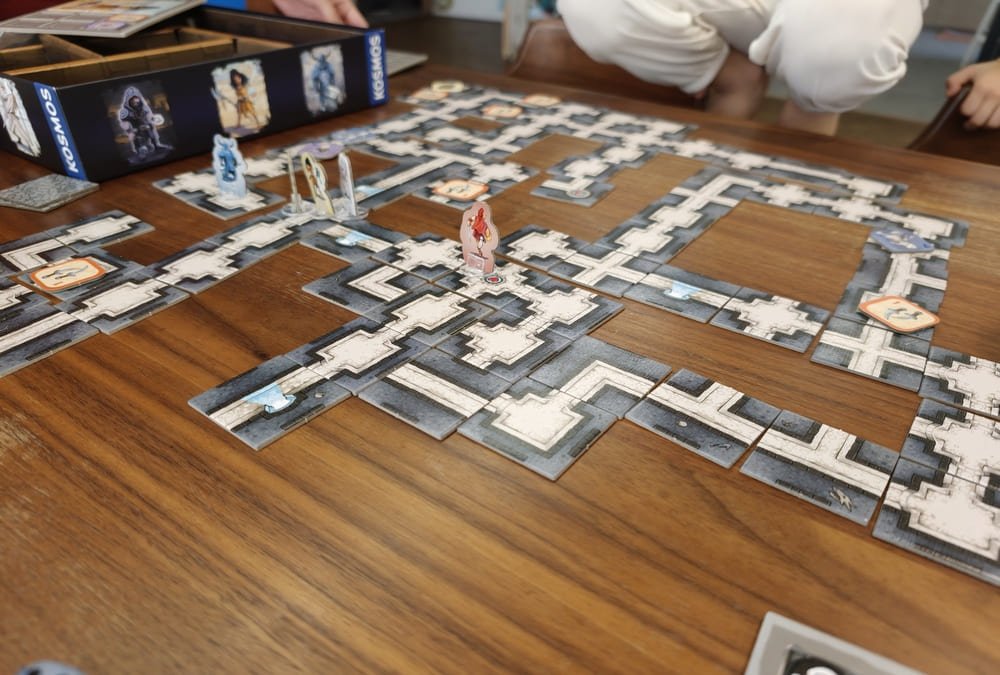
Here’s what sent our first game completely off the rails, in the best way. The dragon tile is shuffled face-down into the pile, so it can surface early or late. Ours turned up dead last — we’d explored nearly the entire dungeon before anyone flipped it. I honestly thought that the dragon tile might not have been in the bag. Every few tiles a kid would ask “is that the dragon?”, it wasn’t, we’d all deflate a bit and carry on. By the time it finally appeared, every hero was loaded to the teeth with weapons and spells.
Which meant the finish wasn’t one dramatic duel. It was a relay. One of us would charge the dragon, whiff the roll or run out of steam, and step aside for the next hero to have a go. Round and round the table. I went in last, my Thief creeping up while everyone else softened it up, and I rolled the hit that finished it. Cue outrage. Cue me being insufferable about it for the rest of the night. It felt less like a kids’ board game and more like the last ten minutes of a fantasy film — the sort where the smallest character sneaks in the winning blow while the big heroes are catching their breath.
Competitive, but weirdly cooperative
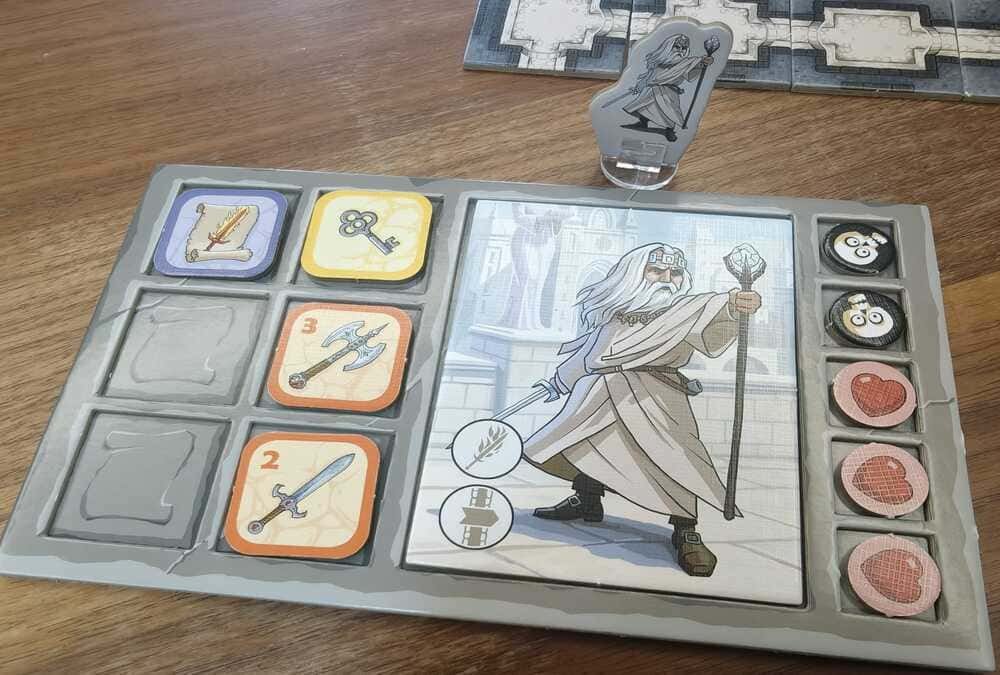
The clever bit is the equipment limit. Each hero can only carry two pieces of gear, so when you find a better sword you have to drop something — and whatever you drop stays on the tile for the next person to grab. There’s this constant low-grade negotiation happening even though everyone’s playing to win.
It also produced the moment of the night. Elliot, my eldest, had his eye on a piece of equipment a couple of tiles away and was mentally spending it already. Then Julian’s turn came first and — of course — he swiped it. I have not seen him go from calm to nearly-flipping-the-table that fast since the last time someone stepped on his Lego. There was a wobble. The table survived. Ten minutes later he’d looted something better and forgotten all about it, which is more or less the whole lesson of the game right there.
Every character plays differently
Each of the six heroes has its own little powers, and I like that the game decides which one looks clever on any given night.
I played the Thief. By the back end I was already stacked with good gear, so I made a call: stop fighting. Every combat ends your turn in Karak, and I didn’t want to burn turns on monsters I didn’t need — or worse, get cursed right before the dragon showed. So my Thief tiptoed past things, skipping fights the others were happily wading into. It looked cowardly. It was cowardly. It also won me the game.
Julian, meanwhile, went full mastermind. He’d memorised every one of his Wizard’s powers before we’d finished setting up, worked out he could fire off his flame scroll again and again instead of once, and came screaming out of the gate as the strongest hero on the table. Then he got creative — plotting to lay tunnel tiles so he could wall the rest of us off while slipping through the passages himself. Ambitious. Also against the rules, as it turned out, which he took about as well as you’d expect a six-year-old criminal mastermind to take it.
That’s the thing about the heroes: on another night, with a different draw, the Wizard’s aggression or a headfirst Warrior is the right play and my sit-back Thief would’ve flopped. The game keeps changing which hero looks smart.
Can young kids actually play it?
The box says 7 and up. The community will tell you 5+, and I’m with the community — with one asterisk. The dice combat is dead easy; my six-year-olds can roll two dice against a monster’s number without any help from me. It’s the spatial stuff that trips them up. Ariel had a proper struggle working out how the tunnel tiles connected and where hers could go, and needed a hand most turns. Julian and Elliot, on the other hand, were coldly rational about the whole thing — reading the board, counting routes, plotting moves ahead like tiny accountants.
So if your kid is five or six and keen, don’t let the 7 on the box put you off. Just plan to sit in for the first game or two, mostly to help with tile placement and to remind everyone what their powers do. After that they’ll be making their own calls — some more ruthlessly than others.
The one real downside
Which brings me back to the clock. That 45-minute estimate is, let’s say, optimistic. To be fair to Karak, we brought it on ourselves — we uncovered almost the whole dungeon before the dragon appeared, and we were slow over our turns early on (see: Miley, asleep). Draw the dragon earlier and move quicker and you’ll land much closer to the box.
But you can’t count on that, and that’s the honest problem. Karak is not the game I reach for on a school night when there’s half an hour before bed and I’m already negotiating toothbrushing. It’s a proper sit-down adventure, and adventures run long. Weekend, June holidays, a rainy afternoon with nowhere to be — those are its slots. Which is why, days later, it’s still sitting there unplayed and I’m still thinking about it.
Should you buy Karak?
For us, easily. Not because it’s the deepest or the best-looking game on our shelf — it isn’t. It’s because it makes stories. In a month I won’t remember the final score of most games we play. I’ll remember the dragon hiding until the very last tile, the four of us queuing up to take a swing at it, Elliot nearly launching the table over a sword, Julian trying to lawyer his way into blocking off half the dungeon, and me sneaking in at the end for the killing blow. That’s the job of a family game, and Karak does it better than almost anything we own.
What we loved
- The constant “what’s under the next tile?” pull — it never stops feeling like exploring.
- The kids feel like actual heroes, not like they’re doing homework with dice.
- Six distinct characters plus a shuffled dungeon means no two games play the same.
- Simple rules that still leave room for a real decision (my cowardly Thief being exhibit A).
What could be better
- It runs far longer than the box claims, especially with a full table and a late dragon.
- Younger kids need a grown-up nearby for tile placement in the first game or two.
Rating: ⭐⭐⭐⭐⭐ (5/5) — with the honest asterisk that you have to give it the time it asks for.
Keep exploring
- 8 Fantasy Board Games That Feel Like Family Adventures — where Karak first made the list.
- The Best Cooperative Board Games for Kids — for nights you want less table-flipping.
- The Best Board Games for Family Game Night — our all-rounders.
- “I’m Bored” — What to Do With No Screens — for the in-between moments.

Pingback: How to Help Your Child Lose a Game Without Meltdown
Pingback: Where to Buy Board Games in Singapore (A Parent's Honest Guide) — Screen Free Playtime