I teach for a living. PE by day, science tuition in the evenings, which means I have spent a large chunk of my adult life explaining things to children and watching, in real time, the exact moment their eyes go somewhere else. It’s a specific look. Anyone who teaches knows it.
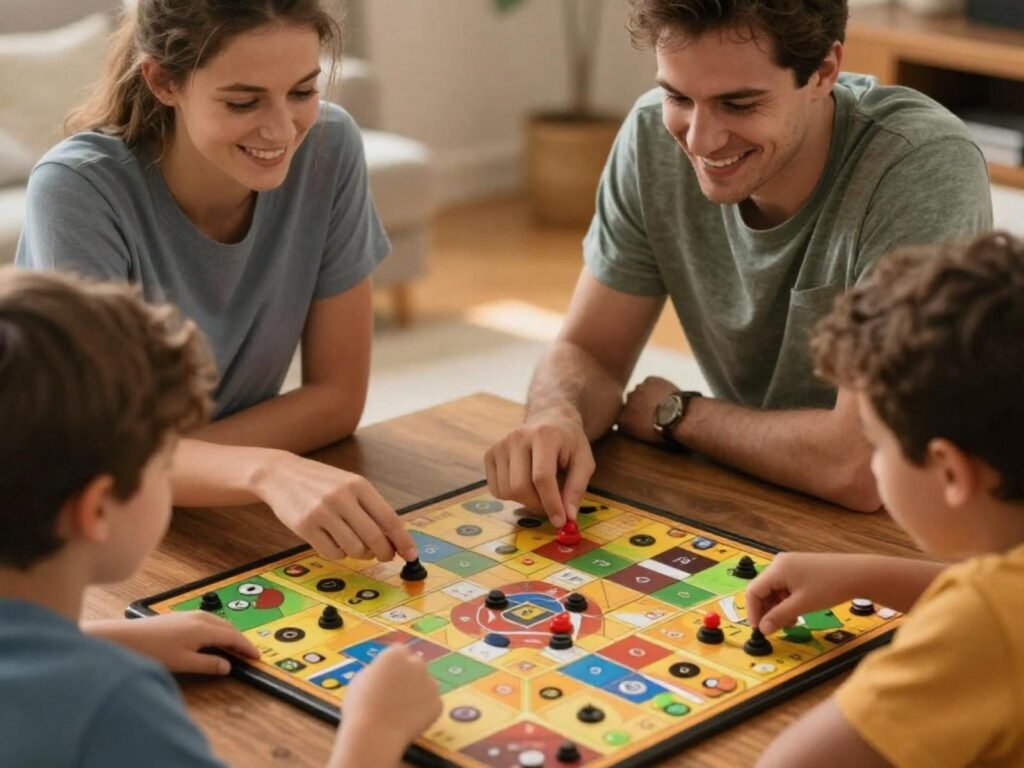
And I still get it wrong at my own dining table. A few weeks ago I opened a new game, sat all three kids down, and started reading out the rules properly, from the top, like a responsible adult. Somewhere around the fourth rule Julian was rearranging the monster tokens into a little army, Ariel had wandered off to get a drink she didn’t want, and Elliot asked how long this was going to take. We hadn’t even started. I was the problem.
So here’s what actually works — some of it borrowed straight from how you teach a new sport to a class of thirty kids who’d rather be running around.
Stop explaining. Start playing.
This is the whole thing, really. Everything below is a variation on it.
You do not teach a child to play football by sitting them down and reading them the offside rule. You put them on the grass, roll them a ball, and explain offside the first time it matters — which, in a game between eight-year-olds, is roughly never. Board games are identical. Set up, hand out the pieces, and start. Explain each rule at the exact moment it becomes relevant, and not one second earlier.
Kids don’t learn rules as a list. They learn them as things that happened. “You rolled higher than the monster, so you beat it” lands permanently. “The combat system uses two six-sided dice compared against the monster’s strength value” evaporates before you finish the sentence.
You do not teach a child to play football by sitting them down and reading them the offside rule. You put them on the grass, roll them a ball, and explain offside the first time it matters — which, in a game between eight-year-olds, is roughly never. Board games are identical. Set up, hand out the pieces, and start. Explain each rule at the exact moment it becomes relevant, and not one second earlier.
Kids don’t learn rules as a list. They learn them as things that happened. “You rolled higher than the monster, so you beat it” lands permanently. “The combat system uses two six-sided dice compared against the monster’s strength value” evaporates before you finish the sentence.
There’s a name for what goes wrong when I lecture them: cognitive overload theory — the thing that gets drilled into you on every teaching course — says working memory can only juggle a handful of new things at once. The estimates vary; some put it around seven, more recent work suggests closer to four. Four. So when I stand there reeling off rule after rule before we’ve even rolled a die, I’m not being thorough. I’m filling up the entire workbench with things they haven’t got a use for yet, and there’s no room left for the game.
The rulebook is for you, and you read it before they sit down. That’s the actual prep work — not explaining well, but knowing the game well enough that you don’t have to.
Hold the advanced rules back
Almost every family game has a layer you can just… leave out of game one. Nobody will notice. Nobody will care.
Karak has six characters with special powers — skip them, everyone plays a plain hero, add them in game two. Ticket to Ride has destination tickets, and the game works fine without them for a first run. Carcassonne has farmers, which I’m not convinced anyone fully understands anyway.
The instinct is that you’re teaching them a “wrong” version. You’re not. You’re teaching them the core loop — the thing they’ll be doing over and over — with nothing in the way of it. Once that’s automatic, the extra layer is a small addition rather than a fifth thing to remember. Skills coaching does exactly the same thing: you don’t teach a full swimming stroke, you teach the kick, then the arms, then you put it together.
Play with your cards face up
For the first game / round, don’t hide anything. Everyone’s hand is visible, everyone can see what everyone else is doing, and you talk about it out loud.
Yes, it destroys the competitive integrity of the game. It’s game / round one and nobody cares. What it does is turn every turn into a small lesson without it feeling like a lesson — a child can look at your cards, see what you’re about to do, and start understanding why one option is better than another. That’s the thing a rules explanation can never give them.
Narrate your own thinking
Say your reasoning out loud, every turn, like a slightly deranged sports commentator.
“Okay, I could fight this monster, but if I do that my turn ends and I don’t get to move again. So I’ll go this way instead.”
It sounds silly. It works absurdly well. What you’re modelling isn’t the rules — they’ll get the rules — it’s the shape of a decision. Kids pick this up faster than you’d think.
I watched it happen with Julian and Karak. He’d worked out on his own that his wizard’s flame scroll wasn’t a one-time thing, and by the second half of the game he was reasoning out loud without any prompting: if I go here, I can use it again, so I should go here. Nobody taught him that. He got it from watching people think out loud.
Watch which part they’re actually struggling with
This is the bit I’d underline if I could only give you one thing.
Kids don’t struggle with “the game.” They struggle with one specific skill inside the game — and it’s usually not the one you’d guess. In our first game of Karak, the dice combat was no trouble at all for my six-year-olds; roll two dice, compare to a number, done. What tripped Ariel up completely was the spatial part — working out how a dungeon tile connected to the corridor she was standing in, and where she was allowed to place it. She needed a hand with that on nearly every turn, while the combat she managed alone.
If I’d assumed “she’s finding the game hard” I’d have helped with everything and taught her nothing. What she needed was help with one narrow thing, so she could do the rest herself.
There’s a name for that narrow band, if you want the theory. Vygotsky called it the zone of proximal development — the gap between what a child can manage on their own and what they can manage with a bit of help. I personally remembered it as ZPD from my Educational Psychology classes decades ago when I was a bubbling and innocent teacher Trainee.
Grand words for a simple idea. Ariel had the combat solo; the tile placement was just past her reach. So that’s the one spot I steadied, and nowhere else. Help them inside that band and they stretch into it. Do the bits they’ve already got, and you’ve only done their turn for them.
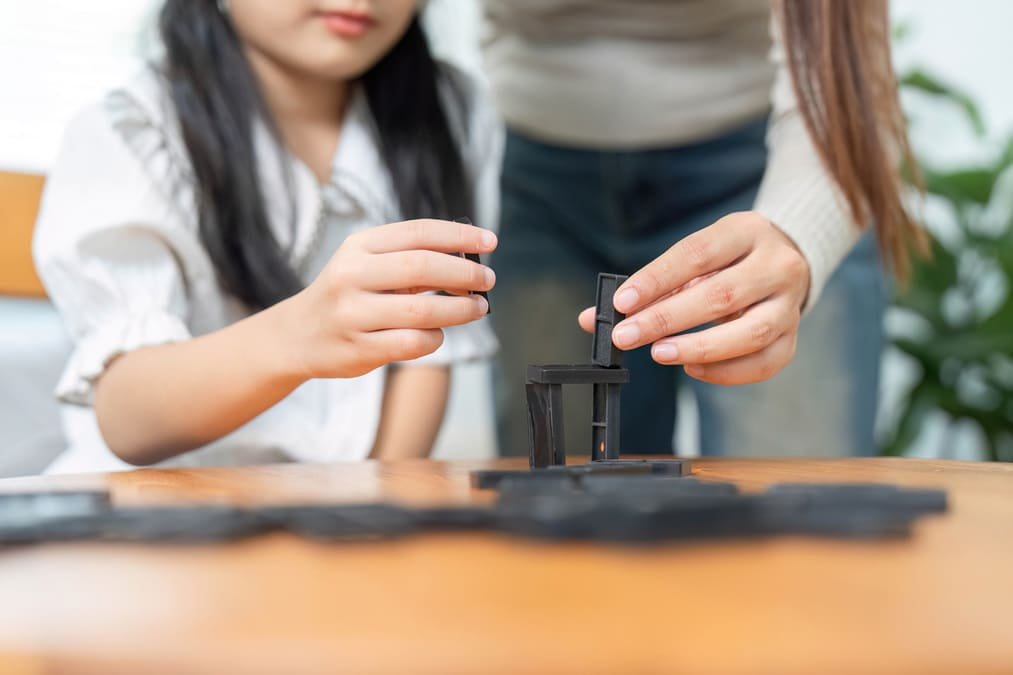
So watch. Reading? Counting? Spatial reasoning? Remembering their own abilities? Find the one thing, support that specific thing, and get out of the way of everything else.
End the first game early if you need to
An unfinished game they wanted to keep playing beats a finished game they endured. If attention is going and you’re only halfway through, call it. Pack up while they’re still asking for another go.
Related: don’t optimise your own play in game one. I’m not saying throw the game — kids spot that immediately and it’s insulting. I’m saying just don’t be ruthless. Play the interesting move rather than the correct one. Let them have the good moment.
The short version
Read the rulebook yourself before they sit down. Set up and start playing almost immediately. Teach each rule the moment it comes up. Leave the advanced layer out of game one. Play open-handed and talk through your own decisions out loud. Find the one specific skill your child is struggling with and support only that. Stop while they still want more.
Kids don’t fall in love with a game because they understood it. They fall in love because something funny or dramatic happened and they were in the middle of it. Get them to that moment as fast as you can, and the rules will sort themselves out.
Try the method on these
- Karak Review — the game most of these examples come from.
- Best Board Games for Kids Aged 5–7 — good first games to practise on.
- 10 Best Board Games for Family Game Night — the all-rounders.
- How to Start a Screen-Free Family Game Night — for actually getting it into the week.