At ages 8–10, children are ready for deeper thinking, longer attention spans, and more meaningful strategy.
This is the golden age where board games shift from “just fun” to brain-building, social-skill-boosting, confidence-building experiences.
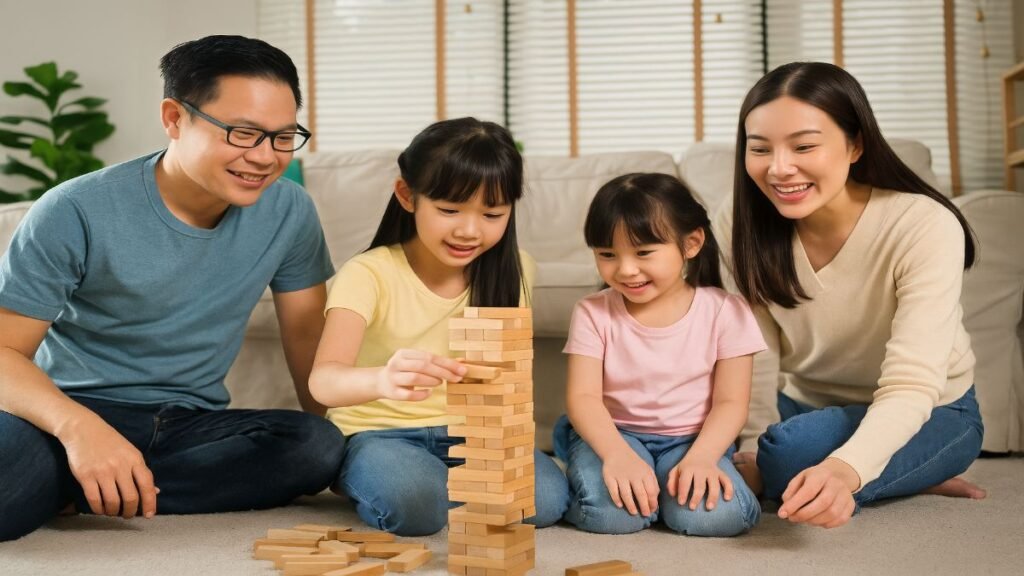
🎯 Why Board Games Matter at 8–10 Years Old
This is often when board games start becoming a shared hobby, not just a kids’ activity.
At this stage, children:
- Think more logically
- Plan multiple steps ahead
- Understand rules better
- Handle winning and losing more maturely
- Enjoy light competition
Board games help develop:
- Strategic thinking
- Patience
- Sportsmanship
- Problem solving
- Teamwork
- Decision making
Below are 5 excellent board games ordered from easier entry-level strategy → deeper thinking, all suitable for family game nights. Feel free to comment if you have other good ones to share too!
Game List
🟡 Sushi Go!
Best for: Ages 6–10
Players: 2–5 (best at 4–5)
Play time: ~15 minutes
Difficulty: 👣👣
Text-heavy: Minimal
Why it works: Scales naturally — younger kids collect happily, older kids optimise strategically.
Sushi Go still makes this list here but it is now considered the lightest game compared to our previous “Best Board Games for Kids Aged 5-7 years old)”
At home, our 6-year-old twins love collecting puddings just for fun. Our 8-year-old plans combinations for the most points, sometimes via sashimi, eating wasabi infused nigiris or shouting sushi go after picking chopsticks.
Same game. Different depth.
That’s what makes Sushi Go such a powerful gateway game. The game moves surprisingly fast too, you pick one card, and you go on to the next, so my more distracted twin stays engaged throughout the game.
🚂 Ticket to Ride Junior
Best for: Ages 7–10
Players: 2–4 (best at 3–4)
Play time: ~30 minutes
Difficulty: 👣👣
Text-heavy: Some
Why it works: Introduces light route planning and forward thinking without overwhelming rules.
My 6 years old twins just place coloured train cards because it feels satisfying.
They’re not always thinking long routes.
Sometimes it’s simply: “I have red. I put red.” But that is kinda fun too; they simply just enjoy it and there is no need to emphasise that combinations at that point, because at one point, they will start to think more deeply in the case of my oldest 8 year old son.
🏰 Carcassonne
Best for: Ages 8–12
Players: 2–5 (best at 3–4)
Play time: ~30–40 minutes
Difficulty: 👣👣👣
Text-heavy: Minimal
Why it works: Tactical tile placement builds planning and spatial awareness with almost no reading.
My kids love tiling.
Even in games that aren’t amazing (we tried Woolly Bully), they enjoy the act of building the map. My mother in law joins in the fun too in our impromptu Saturday morning “Game nights”.
Carcassonne is a game more suitable for ages 8 to 12 really, where my oldest will ask important questions such as “Should I connect this city? or Can I close this road?” Not so much for my twins.
Super rewarding for him when he hits “jackpot”.
🟢 Forbidden Island
Best for: Ages 8–11
Players: 2–4 (best at 4)
Play time: ~30 minutes
Difficulty: 👣👣👣
Text-heavy: Some (manageable)
Why it works: Fully cooperative adventure that builds teamwork and shared problem-solving.
Players win — or lose — together.
Whether you are a pilot, or diver, you have your own role to play, and it is deeply satisfying when you work together and escape with the treasure together. It is definitely Outfoxed 2.0, except it has more nuances and complexities that make it more advanced and suitable for older kids (aka our 8-11 years olds)
🟠 Catan (Family Edition)
Best for: Ages 9–12
Players: 3–4 (best at 4)
Play time: ~45–60 minutes
Difficulty: 👣👣👣👣
Text-heavy: Some
Why it works: Resource management and negotiation challenge older kids ready for deeper strategy.
Catan is louder.
Trades. Negotiations. Dramatic dice rolls.
You’ll hear:
“I need brick.”
“Why won’t anyone trade with me?”
It’s more emotional than the others.
But it’s also where long-term planning becomes real.
And when they finally build that last settlement —
the pride feels earned.
Tips for Playing With Kids Aged 8–10
Short, practical:
- Let kids explain rules
- Talk through decisions
- Don’t rush turns
- Encourage sportsmanship
- Still stop while it’s fun
Final Thoughts
At 8–10 years old, children are ready for more depth — but they don’t always need complexity.
Sometimes they still place trains just because it feels good.
Sometimes they still collect puddings for fun.
Sometimes they negotiate sheep like pros.
The same game can mean different things at different ages.
Start light.
Add depth slowly.
Let the strategy grow with them.
This list isn’t restrictive.
Older kids can still enjoy games for ages 5–7.
You may be surprised how differently they play the same game as they grow.
The game doesn’t change.
They do.
That’s where the real wins happen.
“At this age, the best games grow with your child — and often surprise adults too.”