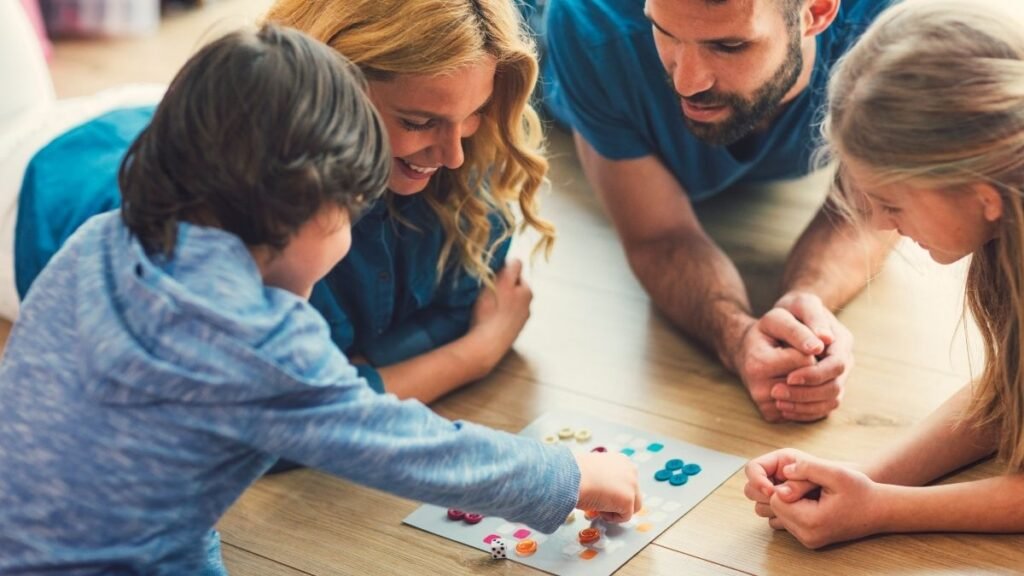
Let me be straight with you before we start: my three are six now, well past this stage, so this isn’t a post I can write from last weekend’s game night. It’s a looking-back post — the games that genuinely worked when mine were three, and obviously some games which I quietly regret buying.
Having been through the chaotic roll of the years — somehow advancing from the prehistoric age of dinosaurs to a medieval one of dungeons and dragons — I’ve watched the whole arc: from a toddler who could barely take turns to kids who now argue over the rules of a dungeon crawler. And I can tell you which early games actually built toward that, and which were a waste of thirty dollars.
Here’s the honest truth about board games for a three-year-old. Most of them are a bit painful for the adult. Your average three-year-old can’t read, can’t really strategise, has the attention span of a goldfish (this sometimes even discredit our dear goldfishes), and would often be caught munching on the pieces than play with them.
The trick therefore, isn’t finding a clever game — it’s finding one that teaches the machinery of playing a game (take a turn, roll the die, wait for me, don’t flip the board) while being just fun enough that you don’t lose the will to live on the fourth round. The games below do that. I’ve been honest about which are genuinely enjoyable and which are educational-but-a-slog.
First, what a 3-year-old actually needs from a game
Before any specific game, it helps to know what you’re actually training, because it’s not “winning.” At three, the whole skill set is the basics of play itself: taking a turn and then — agonisingly — waiting for yours to come round again, rolling a die or spinning a spinner, moving a piece the right way, and coping when things don’t go their way. That last one is enormous at three, which is exactly why nearly every good toddler game is cooperative — everyone versus the game, so nobody has to lose. Save the head-to-head, someone-wins-someone-cries games for a few years down the line.
One practical safety note, because it matters at this age and no listicle mentions it: check the piece size against your particular child. Some three-year-olds have stopped putting everything in their mouths; some very much haven’t. Where a game has a “first” edition with bigger chunkier pieces, that’s the one to get for a younger or mouthier toddler. I’ve flagged it below where it applies.
The games that actually work

One note for regular readers before the list. You won’t see my usual stat cards here — no BGG weight, no complexity rating, no four-star scores. That system is built for judging games as games, and at three that’s the wrong lens entirely. A game for a three-year-old isn’t good because it’s well-designed; it’s good because a small human will actually sit down, take a turn, and not cry when it ends. So I’ve thrown out the template and judged these on one thing only: does it genuinely work with a toddler in the room?
That’s the only rating that matters at this age.
Five that genuinely earn their place, roughly from simplest to slightly-more:
My First Orchard (HABA) · 1–4 players · ages 2+
The one I’d start almost any toddler on. Cooperative and dead simple: roll the colour die, pick that colour of fruit into the shared basket, and race to gather it all before the raven reaches the orchard. The wooden fruit is big, chunky and satisfying to handle — which also means safe for a child still inclined to taste-test the pieces. It teaches turn-taking and colours with zero reading and no losing. This is a genuine first game, not a dumbed-down one.
Hoot Owl Hoot! · 2–4 players · ages 4+ (many 3s manage it)
Cooperative colour-matching: play a colour card, fly an owl to the next patch of that colour, and get all the owls home to the nest before the sun comes up. Box says 4+, but with a hand from you most threes get it — and there’s a lovely built-in dial, because you set how many owls are in play, so it grows easier or harder to suit the child. One of the few toddler games with a whisper of actual strategy, which keeps the adult mildly awake.
Feed the Woozle · 2–5 players · ages 3+
The one your toddler will actually beg to play, because it’s a bit daft. You balance ridiculous snacks — “booger chili,” “hairy pickles” — on a spoon and carry them across the room to feed a monster, sometimes while hopping like a bunny. It’s a dexterity-and-movement game more than a thinking one, which is perfect for burning off a three-year-old’s energy, and it sneaks in counting along the way. Also the game most likely to make the grown-ups laugh, which counts for a lot on the tenth round.
Roll & Play (ThinkFun) · 1+ players · ages 18 months+
Barely a “game,” and that’s the point — it’s the gentlest possible on-ramp for the very youngest end, even under three. Roll the big soft plush cube, match the colour to a card, and do what the card says: make an animal sound, find something red, count to three. No winning, no board, no reading — just the very first idea that “we take turns and follow a prompt.” A good pick if your three-year-old has never played anything structured before.
Sequence for Kids · 2–4 players · ages 3+
The one competitive game I’d allow at this age, because it’s gentle about it. Play an animal card, place your token on the matching animal, get four in a row. There’s no reading, the animals are adorable (a real draw for this age), and there’s just enough “block the other player” to plant the first seed of thinking ahead. A three-year-old won’t grasp the strategy, but they’ll enjoy it anyway — and it’s a soft first step toward games where someone does, eventually, win.
Don’t overlook plain old jigsaw puzzles
Here’s something that isn’t a “board game” at all but earns its place in this post: the humble jigsaw. For a three-year-old, a good puzzle does a lot of the same quiet work the games above do — taking turns if you do it together, sticking with something until it’s finished, and a genuine hit of satisfaction when the last piece goes in. There are lovely toddler-tier ones that blur the line into games, too, like HABA’s matching puzzles where you connect a passenger to their vehicle or an animal to its habitat, chunky two- and three-piece affairs sized for small hands.
I’ll be honest about the trade-off, though, because it’s the whole point of doing them with your child rather than handing them over. A jigsaw is not going to entertain you — there is no puzzle on Earth that’s fun for an adult and appropriate for a three-year-old at the same time. What it is, is one of the best shared quiet activities you can do at this age: you sit alongside, you nudge (“try turning that one round”), you resist the urge to just slot it in yourself, and you let them get there. That guidance is the value.
A three-year-old doing a puzzle alone learns persistence; a three-year-old doing one with you learns persistence and gets twenty unhurried minutes of your attention, which is the thing they’re really after. Cheap, widely available anywhere in Singapore, and a genuinely underrated tool for this exact age. My kids at that age really adore the ones my sis-in-law bought for them back then. Even now, my youngest, Ariel, loves a good puzzle and can sit patiently to work through a 100 piece Paw Patrol puzzle. The other 2 boys simply do not have the patience of such a thorough piece of work and would prefer to dabble with Rush Hour together when it comes to puzzle solving.
The ones I’d skip (and why)
A short honest list, because knowing what not to buy saves you more than another recommendation. The big one: Candyland and its clones. They look like the obvious toddler starter and they’re the game I’d most steer you away from — there are no decisions in them at all. You draw a card, you move where it says, you have literally no choice, and you repeat until someone randomly reaches the end. A child learns nothing except how to follow instructions, and you’ll be bored senseless. Any of the cooperative games above teaches more and is more fun for everyone.
Also worth a caution: plenty of games badged “3+” are really more like 4 or 5 in practice — lots of reading, fiddly little pieces, or rules a three-year-old can’t hold in their head. The box age is a marketing number, not a promise. When in doubt for this age, cooperative-and-chunky beats clever-and-small every time. And you genuinely don’t need many — one or two that click will get played to death, which at this age is exactly what you want, because repetition is how the skills stick.
The point of a board game at three isn’t the game. It’s the twenty minutes of sitting together, taking turns, and learning that this is a thing your family does — a small ritual that, years later, turns into the kid who won’t stop talking about the dragon that showed up on the last tile. Start with one cooperative game that suits your particular three-year-old, keep the sessions short and end them while everyone’s still smiling, and don’t stress about “winning.” That comes later. Right now you’re just teaching them to love the table. Everything good grows from there.
As they grow into it
- Best Board Games for Kids Aged 5–7 — the next step up when they’re ready.
- 7 Best Cooperative Board Games for Kids — more everyone-on-the-same-side games.
- How to Teach Your Child a New Board Game — the method that makes it stick.
- Where to Buy Board Games in Singapore — where to find these locally.