Term 3 of school is a term that passes you by before you know it — short, hectic, and stuffed with half-days. Youth Day, Teacher’s Day, National Day, all of them good for a morning of celebrations and an early dismissal.
Ironically, this is a post that screams “Holidays” when both teachers and parents are still struggling to keep afloat. Yes, it is odd to publish a school-holiday post right in the middle of a term. But that’s the point. The parents who sail through the year-end break are the ones who thought about it now, in July, not the ones scrambling in mid-November when everyone else has had the same idea.
Planning early actually matters here, and not in a vague way. If you want to hunt games down on Carousell — which is where the real bargains are — you might wait a couple of weeks for the right listing to appear at the right price. Leave it to the week before the holidays and you’re paying full retail in a panic, if you can find it in stock at all. So if buying’s on your mind, start with my [guide to where to buy board games in Singapore] and give yourself the runway. Plan late, and you’re setting yourself up to fail.
To be brutally honest, half of me is a teacher, quietly counting down to the end of term like every other exhausted educator in this country. The other half is a dad already scheming about what we’ll actually do with the break — because it’s my holiday too, and a good one doesn’t organise itself. Board games are a big part of my answer, and here’s how I actually use them to get through a long Singapore holiday: sorted by the situations you’ll really be in, not just a list of boxes.
What board games can and can’t do over a long break
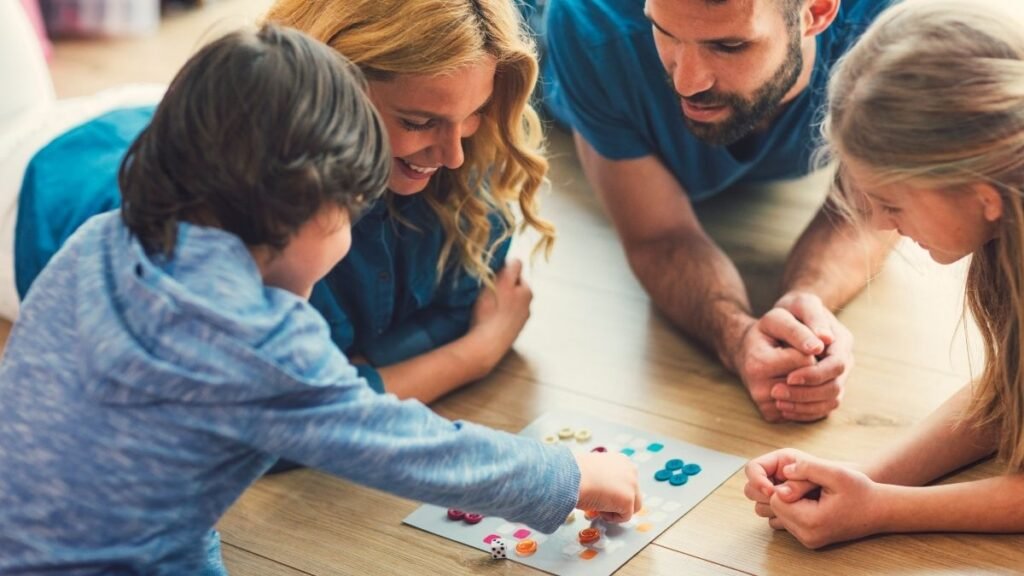
Let me manage expectations first, because a stack of board games do not run the holidays single-handed. They simply won’t. A board game needs an adult in it, at least for the younger ones, so this was never the “hand it over and reclaim an hour” solution. The simple solution is handing over a screen, but that is not our aim. What a game does well is different, and narrower, and honestly more valuable: it rescues the specific part of a holiday day that tends to fall apart.
You know the stretch I mean. Lunch is done, it’s too scorching hot to even let your little twinkie toe get some malicious sun, or the tenacious storm since morning has just killed whatever plan you had, and the kids are circling with that restless energy that ends in either a screen or a royal rumble. That’s the window a game is built for. Drop one into it and the afternoon turns; try to stretch it across the entire day and you’ll both end up frustrated. Right tool, right moment.
There’s a quieter reason the holidays suit games, too. A game you play only once is an expensive mistake. The same game pulled out eight times across a June break becomes one of the cheapest things you’ll do all month, and a long holiday is the only stretch of the year where a game gets that many outings. Of course, in addition to board games, you can consider other screen-free activities. The holidays are when a good box finally earns back what you paid for it.
For the afternoons with nowhere to be
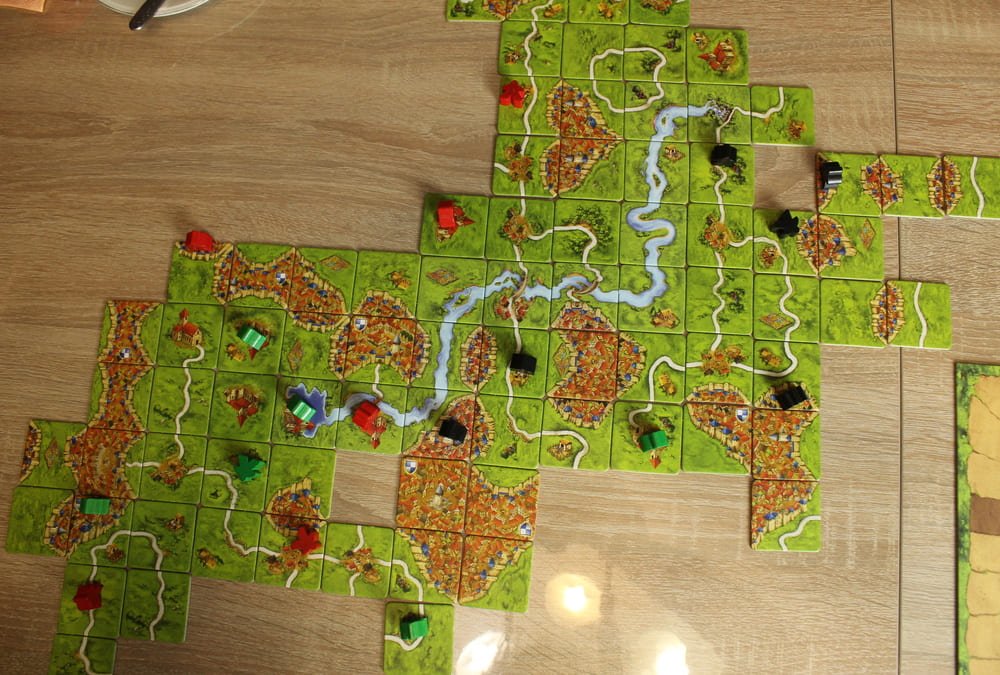
Some holiday afternoons stretch out with no appointments, no errands, nothing. Those are the ones the bigger, meatier games are made for. During term you almost never get a clear two-hour run at a game. The holidays hand you exactly that, which makes them the only time some of the best family games are worth taking off the shelf at all. Two that reliably swallow a whole afternoon:
Karak · 2–5 players · ages 7+ (5+ with help)
The dungeon crawler that becomes the afternoon. You build the dungeon as you go, fight monsters with dice, and race to be holding the most treasure when the dragon falls. Simple enough for young kids, long enough to fill a proper free stretch. Our first game ran two and a half hours. Full review here.
Ticket to Ride: First Journey · 2–4 players · ages 6+
The kid-sized version of the modern classic — collect train cards, claim routes, connect cities coast to coast. Shorter and simpler than full Ticket to Ride, but with the same “just one more turn” pull that makes an afternoon vanish. A brilliant first taste of proper strategy for a six-year-old.
For when the storm rolls in and you’re stuck indoors
This is the one to plan for, because in Singapore it’s less a risk than a certainty. The sky turns at three, when just 30 minutes ago, the sun was threatening to burn you alive. The next moment, the rain comes down like someone up there upended a huge bucket, and the outdoor plan is squashed. It happens all year and it’s near-guaranteed through the year-end monsoon weeks. What you want in that moment isn’t a deep strategic epic — it’s something short and loud that resets fast, so the kids can burn off the frustration of being penned in and go again while the storm blows through. Two that run in fifteen minutes and go again the second they end:
Sushi Go! · 2–5 players · ages 8+ (younger manage fine)
A card-drafting game about grabbing the best sushi off a passing conveyor belt. Quick, colourful, and just tactical enough to keep a grown-up interested — a full game is done in about fifteen minutes, which is exactly what a rained-in afternoon needs. Small box, so it travels too.
Blokus · 2–4 players · ages 7+
Pure spatial puzzle — lay down your coloured pieces, block everyone else, no reading required. Fast, visual, and the kind of game where a younger kid and an adult are on genuinely level ground. Sets up and resets in seconds, so it takes the sting out of being stuck indoors.
For cousins, mixed ages, and a full house
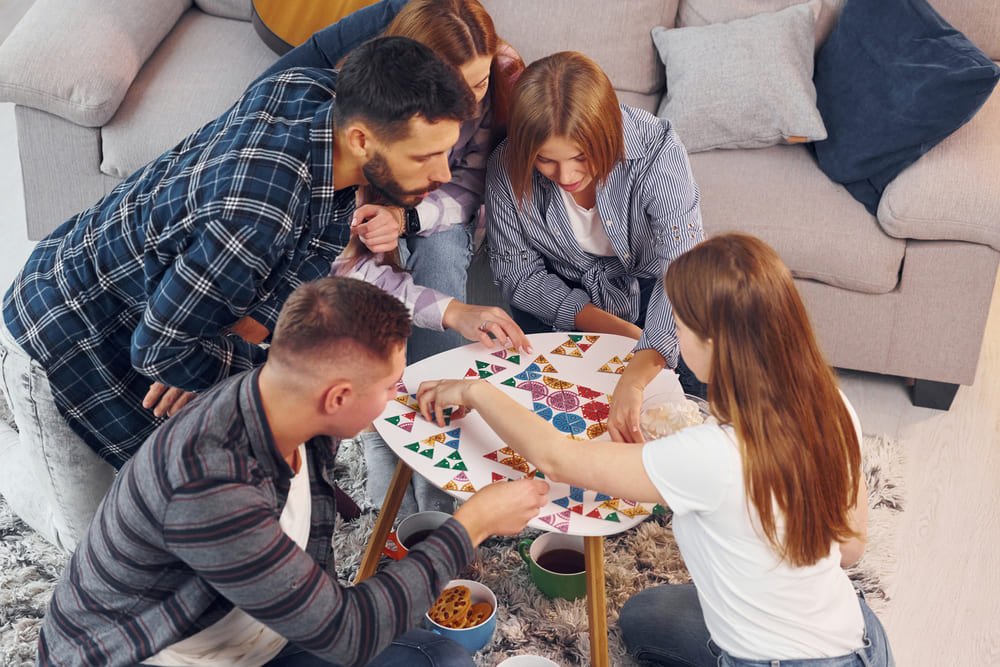
Holidays here mean people. Cousins descend, the family lunch quietly becomes a whole afternoon, a friend gets dropped off while their parents run errands. Before you know it there’s a six-year-old, a ten-year-old and possibly a competitive uncle all wanting in on the same game — and the real challenge is finding one that works for all of them without someone tuning out or getting lost. Two built to hold a spread of ages at one table:
King of Tokyo · 2–6 players · ages 8+ (6+ with a hand)
Giant monsters stomp into Tokyo and beat on each other with fistfuls of dice — think Godzilla by way of Yahtzee. It’s loud, fast, gloriously silly, and luck-heavy enough that a six-year-old can genuinely knock the biggest kid out of the game, which is exactly what you want with a mixed-age crowd. This was the one my friend’s kids couldn’t stop dissecting long after the dice stopped rolling. Scales happily up to six.
Kingdomino · 2–4 players · ages 8+ (7 with help)
The Spiel des Jahres winner — build your kingdom from domino-style tiles, easy to teach in two minutes but with enough real decision-making that an adult won’t be bored letting a child win. Luck and skill sit close enough together that a younger player has a genuine shot, which is exactly what a mixed-age table needs. Easy to find brand new online, too — though I’ll admit I got mine off Carousell, sealed, for ten dollars.
For one child and a slow morning
Not every holiday hour is a full house. Sometimes it’s just one kid and a quiet morning, and you’re trying to clear a few work emails without reaching for the tablet as a bribe. This is where solo games — the kind a child can genuinely sit and play alone — are badly underrated. They’re one of the only honest answers to keeping a child both off a screen and, for twenty blessed minutes, off you.
Rush Hour · 1 player · ages 8+ (Junior version for younger)
A single-player logic puzzle — slide the blocking cars out of the way to free the red one. Comes with graded challenge cards from easy to genuinely hard, so it grows with the child. The closest a board game gets to the satisfying-puzzle itch of a screen, minus the screen. There’s a Junior version for the five-to-seven crowd, and it’s easy to find locally.
Rory’s Story Cubes · 1+ players · ages 6+
Nine dice covered in little pictures — roll them and make up a story from what comes up. Not a “winning” game so much as a quiet imagination prompt, which is precisely what a slow solo morning wants. Tiny, cheap, and endlessly re-rollable. Doubles as a screen-free wind-down.
If I’m being honest, the two solo games I’d most love to put in your hands are Grove and A Gentle Rain — small, cosy, beautiful one-player puzzles that are the closest thing I know to a quiet ten minutes in a box. The catch is finding them. Both are small-run games that go out of stock and rarely turn up in local shops, so they’re the exact reason I keep telling you to plan early and haunt Carousell. I got my own copy of Grove from a Carousell seller who’d kept it as good as new — whereas Rush Hour and Story Cubes above win purely on being easy to actually buy. Sometimes the best recommendation is the one you can get your hands on.
How to not spend a fortune before a long break
One practical warning, because a looming holiday can push you into panic-buying five new games at once. Resist it. Two games that genuinely suit your kids will get more play than five bought at random ever will. If you’re stocking up specifically for the year-end break, the big platform sales — 11.11 and 12.12 — fall right before it, so it’s worth timing a purchase to land then. And for anything expensive, look on Carousell first, where plenty of families offload games their kids have outgrown, often barely touched. I’ve put the full where-and-how in a separate guide, linked below.
Don’t assume the pricey boxes are the good ones, either. Some of the games that have rescued the most afternoons in our house sit squarely in the twenty-to-thirty-dollar range. Some are small and portable as well.
My “For Sale” Travel Edition is fuss free to carry as it sits snugly inside a 60 card deck box and it is genuinely cheap as well. It has survived many trips with us to Malaysia and beyond, and the count will definitely increase. What a game costs tells you almost nothing about how often it’ll actually hit the table.
The honest bottom line
A school holiday is long, and nothing fills all of it — not board games, not screens, not the one big outing or that 7 days 6 nights Japan trip you’ve been promising. What games reliably do is rescue the hardest part of a holiday day: that hot, restless, rained-in stretch where everyone’s fraying and the screen starts calling. Keep a couple of the right ones ready for that window and the whole break runs easier.
And there’s a payoff past mere survival. When my kids go back to school and I ask what they remember of the break, it’s almost never the screen time. It’s the game where the dragon turned up on the very last tile, or the afternoon the whole family got loud over something ridiculous. The holiday is long, but the bits worth keeping happen in those couple of hours around a table. That’s the part worth planning for — ideally, as I said at the top, before mid-November arrives and catches you out.
Games for every kind of holiday afternoon
- Karak Review — the one that becomes the whole afternoon.
- 7 Best Cooperative Board Games for Kids — for mixed ages and a full house.
- 10 Best Solo Board Games for Kids — for one child and a quiet morning.
- 9 Best Travel-Friendly Games for Kids — for holidays that actually go somewhere.
- “I’m Bored” — What to Do With No Screens — 30-plus screen-free ideas for the in-between hours.
- Where to Buy Board Games in Singapore — before the year-end sales hit.