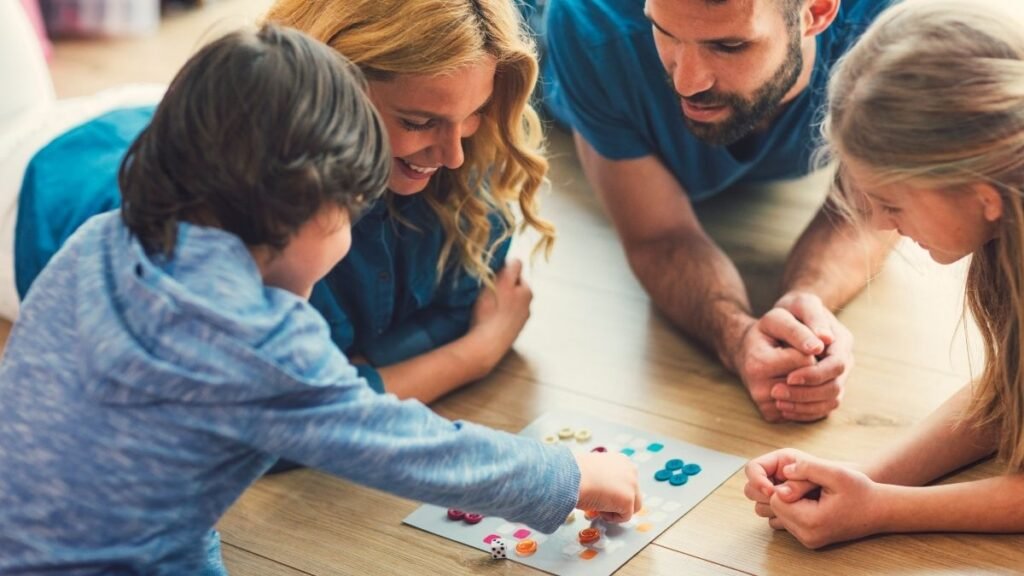
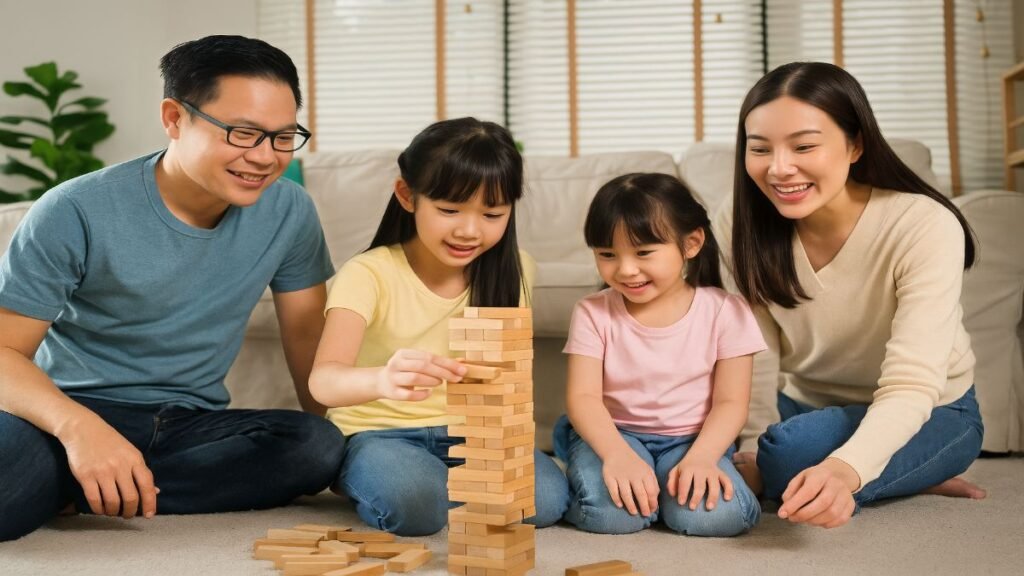
Most of what I write here is about family game night — the whole table, everyone in, chaos and all. Last Sunday, on actual National Day, it was Karak: Julian dominating the board, “sticking” his axe clean into the dragon’s heart and making off with the treasure hoard for himself.
His uncle, before Julian got in the decider, played Victorius the swordsman — and spent the first half of the game utterly unstoppable. The swordsman keeps going every time he rolls a six, and my cousin-in-law reeled off two straight double-sixes, obliterating monster after monster on a power of 5, before running headlong into the Skeleton King with a power of 10 and cowering there with a measly 5, the mighty swordsman suddenly very ordinary. He ended the game with zero treasures. That’s Karak. That’s the whole table roaring one minute and howling with laughter the next.
But some of my favourite gaming with my kids happens quietly, on a weekday afternoon: Elliot taking a break from his primary school homework, or done for the day, and the two of us pulling out something small. Connect 4 is his current obsession. He earned his copy by trading in the good-behaviour points he’d collected at school — his choice, out of everything he could have picked — and now it goes everywhere with him, tucked into his yellow Baby Shark bag. He brought it out yesterday (Public Holiday Monday), and it happily occupied him and the twins while the adults finished their meal. There’s something about a game a seven-year-old chooses to carry around that tells you it’s doing its job.
“2–4 players” is not the same as “good with two”
Here’s the trap, and it’s worth understanding before you spend any money. A box that says “2 to 4 players” is telling you the game functions with two. It is not promising it’s any good with two. Loads of family games technically run at two players while quietly falling apart, because the whole fun of them depends on a crowd.
I’ll give you three from my own shelf. King of Tokyo is a riot with four or five — monsters ganging up, everyone piling on whoever’s foolish enough to be sitting in Tokyo. My son and I love it. But head-to-head it’s a weaker game: whoever grabs Tokyo first tends to snowball into a win, and the glorious pile-on that makes it sing just isn’t there with two.
Sushi Go is another one — I’ve genuinely played it two-player by dealing out a dummy third hand just to make the card-drafting work properly, which tells you everything you need to know about the player count it really wants.
And Draftosaurus, lovely as it is with the kids, is a drafting game at heart, and drafting wants a crowd — its two-player variant works, but it turns into a meaner, sharper thing that the wider gaming community generally agrees is a step down from playing it with four. All three are more-the-merrier games.
So this list is deliberately not “family games that tolerate two.” It’s games that are either built for exactly two players, or that the board-game community broadly agrees are at their best with two. There’s a real difference, and it’s the difference between a game you’ll keep coming back to one-on-one and one that slowly migrates to the top of the storeroom shelf. There are no hard and fast rules though; Elliot enjoys playing King of Tokyo with me alone. Nothing wrong with that — they’re just not what this list is about.
Why 2-Player Board Games is worth doing
It’s easy to treat one-on-one gaming as the consolation prize — the thing you settle for when you can’t wrangle a full table. I’d argue it’s the opposite, and it took me a while to see it.
In a flat with three kids, undivided attention is a scarce currency, and they compete for it fiercely. We don’t own a car — we’re a public transport family, on the trusty bus and MRT everywhere — and even something as small as which child I sit next to on the bus can set one of them off. Sit with Julian and Elliot’s face falls; sit with Elliot and Julian’s does. They both want the seat beside Dad, and neither is shy about it. Most of our time together gets split three ways like that, someone always half-waiting for a turn or half-melting down in the background.
A two-player game quietly solves that. It’s just your child and you, no one else pulling at your sleeve, and they notice — kids clock undivided attention far more than we give them credit for. It’s also where they improve fastest, because every single turn is one you can talk through with them, with nobody else waiting on you to hurry up.
And for half an hour, the thing they’re always fighting over on the bus is simply theirs. No sharing it with a sibling, no waiting their turn to be heard. Just you, looking at them, listening to them, all the way to the end of the game. Think about how rarely a child in a busy family actually gets that — one adult, undivided, with no phones, no other kids tugging your arms, nowhere else to be. That’s what you’re really handing them.
The gentlest place to start
The one he takes everywhere
Sometimes the best two-player game is the simplest one. Drop your discs, get four in a row before the other person does, block them when they’re one move from winning. It plays a bit like tic-tac-toe’s bigger, cleverer cousin — easy enough for a six-year-old, but with just enough “if I go here, he’ll go there” for a child to start genuinely thinking ahead. Elliot earned his copy trading in school good-behaviour points and picked it over everything else on offer, which tells you how much a kid can love a game that costs almost nothing. It lives in his bag and comes out everywhere — the car, the void deck, a National Day afternoon.

For younger kids (around 5 – 7)
The cheapest way into two-player strategy
The two-player-only version of Blokus, and reviewers who’ve played both reckon it’s actually better than the four-player original. You each lay pieces so every new one touches your own colour only at the corners, racing to fit down more before you both get boxed in. No reading, no luck — pure spatial puzzle, so a seven-year-old competes with a parent on completely level ground. Teaches in three minutes, sets up in one.
The gentle, beautiful one
You each lay tiles to extend a winding path, keeping your own stone travelling as long as possible without running off the edge or colliding — last one on the board wins. Beautiful, wordless, and simple enough that many kids play it competitively from five. Honest note: it’s rated just a whisker below our usual 6.5 cutoff on BoardGameGeek, and at two players the opening is a touch slow — you spend the first few tiles keeping out of each other’s way before the paths tangle and it gets tense. We kept it in anyway, because for a young child one-on-one it’s hard to beat.
For the 7 – 10 Crowd (The sweet spot)
The one to buy if you buy only one
Designed from the ground up for exactly two. You’re both building a quilt from Tetris-shaped fabric pieces, spending buttons and time, trying to fill your board more cleverly than the other. It teaches in five minutes, and has the rare quality of feeling completely fair every single time you lose. Looks cosy, plays quietly cut-throat. Comfortably clears our usual rating and complexity bars — a genuine modern classic for parent-and-child play.
Fast, tense, one-more-round trading
One of the cleanest competitive two-player designs ever made. A fast card game about trading goods at a market — camels, spices, gems — and being the richer merchant at each round’s end. Quick, tense, and blessed with that “one more round” hook that makes a school night quietly evaporate. Officially 10+, but a switched-on eight- or nine-year-old gets it after a couple of plays. Clears our rating and complexity bars easily.
For older kids ready for a proper duel (9+)
“Nature chess” — a proper duel
Think chess, but with bugs, no board, and rules you teach in three minutes. Each player’s tiles are insects that move in different ways, and you’re both racing to surround the other’s queen bee. Pure two-player strategy with zero luck — so when your kid finally beats you, they’ve earned it outright. Honest note: this one’s heavier than our usual family picks — it sits above the complexity line we normally hold to. We’ve included it deliberately, because for an older child ready for a real head-to-head brain-burner, it’s one of the best there is, and the durable tiles travel anywhere.
A first taste of trick-taking
A two-player-only trick-taking card game — the kind of card play their grandparents would recognise, wrapped in lovely fairy-tale art. You win tricks, but taking too many actually loses you the round, which creates a constant tension over whether to win or deliberately duck each hand. Clever, cheap, and it packs down to a deck of cards for travel. Clears our usual bars, and it’s a great “graduating” game for a child who’s outgrown the lighter picks.
The Honest Bottom Line
n the end, the game matters less than the ritual. Two players, one table, nobody to referee — protect that, and the specific box barely matters. Pick one that suits your child’s age, make it a regular just-the-two-of-you thing, and let them start beating you for real the moment they can. You don’t need to spend much to start, either — a second-hand Blokus Duo off Carousell costs about the same as kopi and pratas for 1 adult and 1 child, and it’ll outlast most things you could buy for the price. It was never really about the winning. It’s the half-hour across a small table, the one that belongs to just the two of you — and those add up to more than you’d think.
More ways to play together
- 10 Best Solo Board Games for Kids — for when it’s just them and a quiet morning.
- 7 Best Cooperative Board Games for Kids — for when you want everyone on the same side.
- Helping Your Child Lose Without a Meltdown — it matters most one-on-one, when there’s nowhere to hide.
- Where to Buy Board Games in Singapore — including the Carousell bargains.