If you like the idea of family game night but keep thinking
“Nice in theory… but we’re exhausted by 8pm”
You’re not alone. (Don’t you feel like you are living in a zoo sometimes? That’s me.)
Well, most families don’t fail at screen-free game nights because they don’t care.
They fail because they overthink it.
The good news?
A screen-free family game night doesn’t need planning, Pinterest boards, or two free hours.
It just needs one small habit done consistently.
Here’s how to start — even if you’re busy, tired, and already negotiating bedtime.
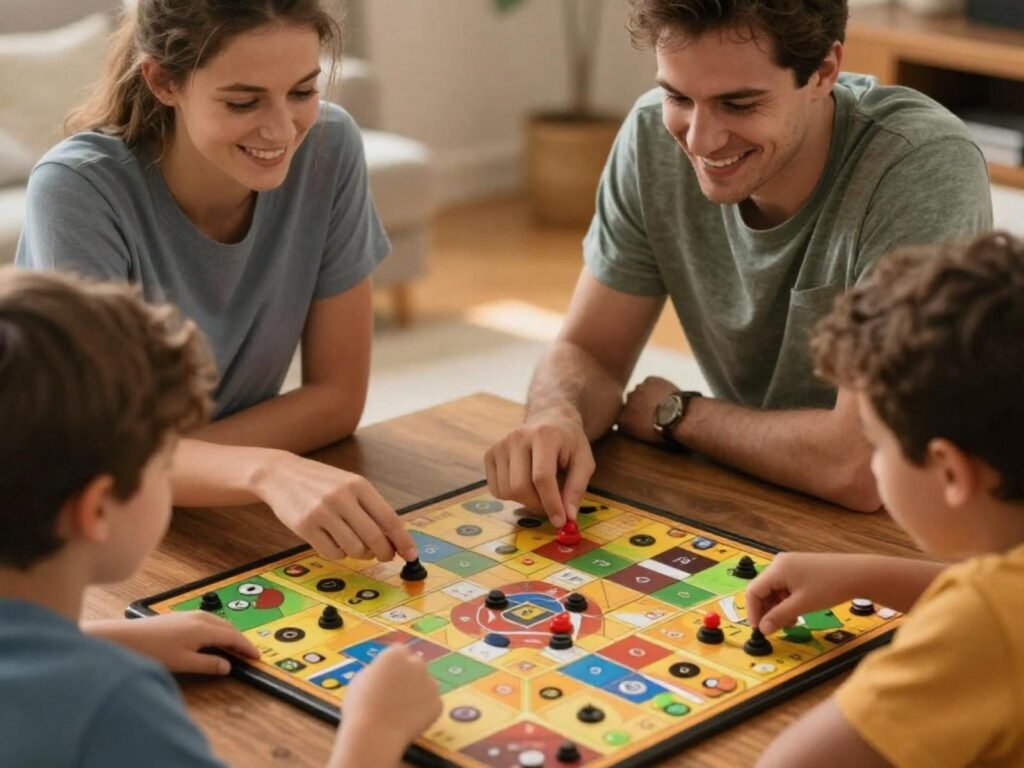
Let’s explore how to start a screen-free family game night, even if you’re busy.
First: Reset Your Expectations (This Is Key)
Let’s get this out of the way.
A screen-free family game night:
- ❌ Does NOT have to be weekly (yet)
- ❌ Does NOT last an hour
- ❌ Does NOT involve “perfect behaviour”
If you aim for:
- 20–30 minutes
- Once every 1–2 weeks
- Everyone laughing at least once
You’re doing it right.
Consistency beats intensity every time.
Step 1: Pick One Fixed Time (Not a Flexible One)
“Whenever we’re free” never happens.
Instead, anchor it to something that already exists:
- After dinner on Friday
- Before dessert on Saturday
- Sunday afternoon when everyone’s home
It doesn’t have to be the same day every week — but it does need a default.
Once kids expect it, half the resistance disappears. Even if there are only 30 minutes, I could still squeeze in a fast paced and hilarious game in less than 20 minutes.
Step 2: Choose Games That End Before Kids Get Bored
This is where most parents accidentally sabotage game night.
Early on, avoid games that:
- Take 30 minutes to explain
- Knock players out early
- Drag on with no clear end
Instead, start with games that:
- Have simple rules
- Finish in 10–20 minutes
- Allow rematches or quick resets
If you’ve already read our guide on
10 Easy Board Games for Family Game Night That Don’t Need Screens,
this is where those picks shine.
Short games leave kids wanting one more round — which is exactly what you want.
Step 3: Let the Kids Win (At First)
This might sting a little… but it matters.
When kids are new to board or card games:
- Losing too often = instant shutdown
- Winning builds confidence and interest
You don’t need to throw the game obviously.
Just make gentle choices, offer hints, or celebrate effort over results.
Later on, once game night becomes normal?
Then you can play properly 😄
Step 4: Keep the Rules Loose in the Beginning
Early family game nights are not about rule accuracy.
They’re about:
- Turn-taking
- Talking
- Laughing
- Staying at the table
If someone forgets a rule or bends it slightly — let it go.
You can tighten rules over time.
Right now, the goal is positive association.
Step 5: End on a High (Even If It’s Early)
This sounds counter-intuitive, but it works.
If the game is going well:
- Stop before kids melt down
- Stop while everyone’s still smiling
Say something like:
“Okay, we’ll stop here and play again next time.”
Ending early makes kids look forward to the next session instead of dreading it.
What If Your Kids Say “This Is Boring”?
Totally normal.
A few things that help:
- Start with fast games, not strategy-heavy ones
- Play cooperatively instead of competitively
- Join in fully — phones away, distractions gone
Kids mirror adult energy.
If you’re half-present, they’ll be too.
One Simple Rule That Makes Everything Easier
Game night is optional — showing up is not.
Kids don’t have to love every game.
They just have to sit down and try.
Over time, they’ll find favourites.
That’s when game night becomes something they ask for.
Final Thought
Screen-free family game night isn’t about replacing screens forever.
It’s about creating:
- A shared habit
- A shared table
- A shared memory
Start small.
Keep it light.
And don’t wait for the “perfect” moment — it doesn’t exist.
If you want ideas for simple, beginner-friendly games,
check out our next guide on board games for kids aged 5–7,
or bookmark this page and build from here.
Pingback: 5 Card Games That Take Under 10 Minutes (2026) – Screen Free Playtime